





At twenty-seven, on vacation in Cuba, Dana Lyn locked herself in a bathroom and put both hands flat on the counter. On the other side of the door, the man she had been with since the start of her twenties was screaming over music turned all the way up. Earlier that night he had locked her out of their rental. There was no cell service. She had to wake her friends and tell them her boyfriend had locked her out, and then she had to go back in.
“I remember looking myself in the eyes,” she told me, “and putting my hands on the counter, and saying, you are not going to do this forever.”
It would take three more years.
She told me this on a Friday morning on Zoom, from her home office in Southern California. Behind her, out of frame, her dog Phoenix was sleeping off a trip to the vet. Dana had mentioned the dog before we even started recording. Then, without being asked, she had told me the rest: the shelter in Palmdale, the pregnancy nobody mentioned, the four days’ warning, the twelve puppies born in a two-bedroom apartment by the beach.
She laughed and lifted her Yeti cup.
That is how Dana arrives. Story first. She does not warm up. She is already warm.
“I remember looking myself in the eyes, and putting my hands on the counter, and I said, You are not going to do this forever.”
HAPPY IS NOT THE WHOLE STORY
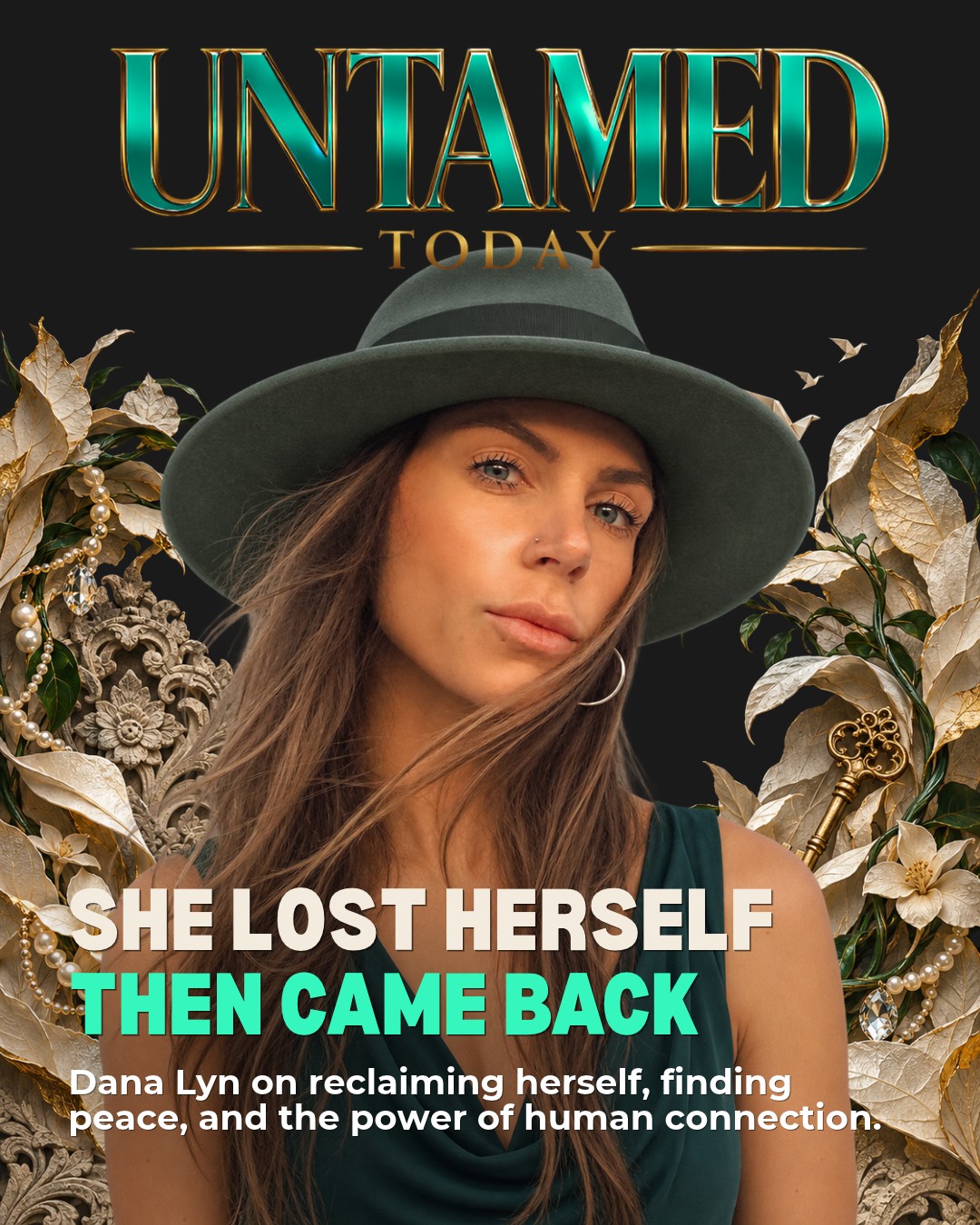
She is thirty-seven. She has spent fifteen years in healthcare, helping launch practices and grow them. What she learned is that a business isn’t built on systems alone. It’s built on people. Today she carries that into her work as a business consultant.
She organizes wildfire relief on her own, with no organization behind her. She could, in her own words, “have a riveting conversation with a tree stump.” She smiles with her eyes.
So I asked her what the people who admire her most still get wrong.
“That I’m happy all the time.”
She is happy; she wanted that clear. She was a happy kid. But to the people who love her, her happiness had become a kind of proof that nothing had ever touched her.
“There’s a constant question: how did you go through that?” she said. “Like everybody else. Blood, sweat, tears. I’ve had many tear-stained pillow nights, and that’s okay. I’m human.”
To explain, she told me about people she knows who lived through the same kind of hardship and came out on very different roads.
“You can either take the red pill or the blue pill,” Dana said. “You can say, well, I’m this way because this happened to me. Or you could do the latter. I made this of myself because I went through this.”
It took most of the next two and a half hours to understand what “this” meant.
“I’ve had many tear-stained pillow nights, and that’s okay. I’m human.”
THE NIGHT SHE CHOSE
For the decade of her twenties, Dana lived inside one relationship. He was, she says, the funniest person she had ever met.
“I wish I had met him as a friend,” she told me, and she meant it as a kindness, which is its own kind of evidence.
He was also violent.
People always ask why she stayed. She answered without defending herself.
“It’s not an active choice. You become a shell of a human. When you are so put down, you don’t really believe that you are worth anything. It’s not like you enjoy the torture. But you just start to believe you’re not worthy of anything else.”
What got her out was not strength. She insists on this.
“I wasn’t strong. I was the weakest I had ever been.”
It was a birthday with a zero in it. Near thirty, she sat herself down and asked the questions she already knew the answers to.
Did she want to be a mother? She has wanted that since she was a child.
“I nurture to the fullest.”
Would he be a good partner? A good father?
“You already know the answer to that one.”
So she planned it. That is the part I keep coming back to. She did not wait for the last bad night. She chose it.
“There came a night when I put my war paint on,” she said.
She knew it would be dangerous. She did it anyway. In the early hours of that Sunday morning, she made it to a police station and walked out with a restraining order.
“That was my goodbye.”
No last conversation.
“No closure from a decade-long relationship. All down the drain in the blink of an eye.”
The next morning, she admits, part of her wanted to take it back. The order made that impossible.
“It’s final,” she said. “There was no turning back, even though I shamefully wanted to.”
I told her what I believe: that sometimes the bravest thing a person can do is close the back door, so there is no other way out. She nodded before I finished.
A week later, the apartment below hers caught fire. Then the water pipes burst in her apartment. Through the holes in the walls came cockroaches. She is absolutely horrified by insects.
“You have no idea…” she said twice. “The man’s not around anymore. I am terrified. I’m heartbroken.”
Losing her father was the darkest moment of her life. Leaving that relationship was harder in an entirely different way. By the time she lost her father, she knew who she was. When she left that relationship, she was still trying to find herself.
She did not soften it.
FINDING DANA
Then came the part she calls the most beautiful thing that ever happened to her.
She had to find out who Dana was.
“Every single thing was with him,” she said. “I was like a barnacle on a boat that I didn’t want to be stuck to, but I was.”
She did not know what she liked. She did not know how to be alone.
“I was like a barnacle on a boat that I didn’t want to be stuck to, but I was.”
A month after she left, her cousin had an engagement party in San Francisco. Dana registered her three-and-a-half-pound chihuahua, Norma Jean, as an emotional support dog so the two of them could fly together. At the hotel, she could not sleep in a room by herself. Her parents had one bed. She took the other.
“My poor parents,” she said.
A friend was going to Bali that August and asked her to come. Dana said there was no way. The thought of traveling and being away from her dog gave her crippling anxiety. Another friend told her to just buy the ticket and “go fall in love with some hot Australian in Bali. You’ll get over it.”
She thought she couldn’t. She gave herself a million reasons why it wouldn’t be a good idea.
Two weeks before the flight, she bought the ticket.
“I need to face my fears.”
Two days into her trip, she did indeed meet an Australian, as her friend predicted. Three days, a whirlwind of adventures. When he left, Dana did something she had not been able to do in that San Francisco hotel.
She rented a villa by herself.
“It was that moment that I went, oh my God! She’s back! Let’s go!”
She took herself to dinner. Live music.
“Nothing can disturb us,” she said, and I noticed the “us,” as if the woman she had lost had been sitting at the table with her the whole time.
“Because I know that there is worth now.”
“Oh, my God! She’s back! Let’s go!”
THE HARDER WORK
If the story stopped in Bali, it would be a good story. It doesn’t, and that is what makes Dana worth listening to.
When I asked what she had been certain of at sixteen, she gave the obvious answer and laughed at it. “The guy that I was with, I was gonna marry.”
The real answer came later, and it was less flattering.
For most of her life, she had believed that being a good person was enough. She put air quotes around the word “coasting.”
“I coasted through life knowing, okay, Dana, you’re a good person.”
In 2023, at thirty-four, she had just broken up with a later boyfriend, a man she is still on good terms with. She told him she was driving over to his house right then.
He said, “You’re not taking my emotions into consideration; you’re doing it again now.”
“I remember I was in the car. I remember what street I was on. And I went, oh my gosh. I am doing it.”
She described what happened next as electrical.
“It’s like all these cords and wires, and they’re all lit up, going haywire, desperately needing sockets to plug into.”
She found a local woman who gives spiritual readings and life-path guidance. In one session, the woman helped her plug in those cords and wires. The line Dana carried out of that room:
“Whatever patterns you have learned that don’t serve you, you can also unlearn.”
Then she did something most people never do. She called her friends and family members, one by one, and apologized for things they had not even noticed until this epiphany.
“Everyone said, ‘No, you’re fine.’ I said, ‘No, no, no. Because I see this now. And it’s not something I want to carry anymore.’”
She calls that the biggest accomplishment of her life. Not surviving. Looking. Looking inward, and healing the parts of herself she no longer wanted to define her.
She was not only asking what other people had done to her. She was asking what she could do differently for the people she loved.
“It takes guts,” she said. “It takes guts to really look at yourself and go, that’s not a good part of me. I don’t want to carry that anymore.”
I asked what the woman she is now would say to the girl she was. She leaned into the camera. “It’s okay. Whatever has happened, whatever will happen, it’s okay. We’re going to be alright.”
“Whatever patterns you have learned that don’t serve you, you can also unlearn.”
HUMILITY, AND THE BODY
Ask Dana what she gave up to become herself, and she corrects the question.
“I wouldn’t say I needed to give up. I had to accept. I had to learn to accept humility, and still work on it every single day.”
She feels it in her chest, up into her throat, and in her solar plexus, and her hand went to each place as she spoke.
“Humility can feel humiliating at first. It’s uncomfortable to recognize something about yourself that you don’t like. But that discomfort is where growth begins.”
Her tool for almost everything now is curiosity. Ask why. Then ask why again, until you hit the bottom.
I have built my own work on that one word for years. It was a strange comfort to hear someone arrive at it from the other direction.
Some of that curiosity she turns on her own body.
During COVID, her father, Bill, was diagnosed with acute myeloid leukemia, an aggressive form of blood cancer. He underwent seven rounds of chemotherapy and spent a month and a half in the hospital for a bone marrow transplant, with his own brother as a 12/12 match. He came home, and they thought they were out of the woods. Eighty-seven days later, the cancer came back with a vengeance. He spent his last two months in a hospital that allowed no visitors due to COVID restrictions. At Christmas and New Year’s, Dana and her sister had to wave to their father on the seventh floor from outside his hospital window.
She saw him again only in the two weeks he came home on hospice care.
Her whole body broke out in a rash. Eyelids, cheeks, neck, chest. Her legs were bruised.
Doctors suggested eczema, an allergy.
“I knew it wasn’t eczema. My father is dying. I am stressed out. My body is literally rejecting the stress.”
She said it without bitterness.
“God bless modern-day medicine. But also, not everything can be fixed with an ointment or a pill.”
GUARDING THE DOOR
I asked if there was something she wanted that would surprise the people who know her best. She found it slowly.
For most of her life, she was the one with thirty-five people at a birthday dinner, all from different friend groups, all getting along because they all belonged to her.
900 text messages a day.
“You need me? I’m there.”
Now? She guards the door.
She steps away from the rooms that would cost her peace, even the family ones. She still makes room for love. She is just more careful where she puts herself.
“At what cost to my peace?” she asked.
“I went out with everybody,” she said, “and now I go out with myself, and I’m damn happy to do it.”
“I went out with everybody, and now I go out with myself, and I’m damn happy to do it.”
I told her what happened to me. The first time I felt real peace, I thought I was depressed. I had never felt it before. One day I told myself, you’re not depressed, Jesse. This is what peace feels like.
“Boom,” she said.
The year that tested that peace most was last year. Her Nana, whose saying runs under everything Dana does, “Where there’s a will, there’s a way,” passed away in February. Then, her dog Norma Jean, fourteen years at her side, died the next month.
Around the same time, she lost her role at a dental practice she had poured herself into building. The hours were punishing. The stress reached her body. Losing it hurt.
“I was relieved,” she said, chin in her hand, choosing her words slowly. “I learned that other people’s opinions don’t define who I am. I know my character. I know how I show up in this world.”
She has a Gemini’s way of holding two things at once.
“I don’t always have to be column A,” she said. “Column B is there.”
Later, she read me something a friend once told her about astrology. Your rising sign is your front door, the version of yourself the world first meets. Your sun is your living room, where the people you trust are welcomed. But your moon? That’s your bedroom. The place only a select few are invited into.
Her moon is in Leo.
That bedroom, she says, is where the fire is.
I noticed her rings then. Crystal, on several fingers. Her hands were rarely still.
FIGHT ON, BILL
When I asked for the truest thing she has never said out loud, she told me there is no such thing.
“There’s nothing I haven’t told somebody.”
She tells people everything on purpose.
“I am a member of the club of lost daughters,” she said.
When someone near her loses a father, she checks in. When someone is diagnosed with cancer, she tells them she had it at age twenty-four.
“I’m opening the door to say, you’re not alone.”
I told her she had just answered my own reason for doing this work.
“I am a member of the club of lost daughters.”
She learned what community can do when her father got sick. She posted about him in an online support group called the South Bay Support Pantry, where strangers helped one another through the hardships of COVID.
“This is my father. He’s the goofiest guy. He’s a dentist. He loves USC football. He’s a surfer. He is going in for his first round of chemo in a week to fight the toughest battle of his life. If anyone feels inclined to send well wishes, let me know.”
More than a hundred strangers answered. Cards. Care packages for chemo: sugar-free suckers, socks, beanies, blankets.
A man who worked for a sign company made an eight-and-a-half-foot banner.
FIGHT ON, BILL.
“We put it behind,” she began, and stopped. “Ooh. Whew. Got the chills. I’m getting a little emotional.” She found the sentence again.
“We put it behind the podium at his memorial, and that big banner we still have today.”
Her eyes were wet, and so were mine.
“I don’t want to tear up and cry right now because I’m sad,” she said. “It’s this overwhelmingly joyful feeling that people can band together and really make a difference.”
There is a word for this. Kama muta. Being moved by love, by people giving with their whole hearts. Dana has her own word for it, from her mentor. She calls it God bumps.
It happened to her again last year, with Phoenix.
She went from a three-and-a-half-pound chihuahua to a sixty-eight-pound shepherd with kennel cough and parasites. Phoenix had been rescued on the day the shelter planned to euthanize her. A month later, as her stomach grew, the vet showed Dana an X-ray with at least ten puppy spines visible.
Due within the week.
She screamed in her car on the drive home that Sunday afternoon. Phoenix was in the back seat, vomiting.
After giving herself 24 hours to freak out, she said the next morning, “Time to put your big girl panties on, Dana. We’re going to deliver puppies.” She then went back to that same support group that was so kind to her about her father, and she asked strangers for help.
A kiddie pool, a whelping station, heating pads, bottles… the works.
“I had everything that I needed in just two days.”
Twelve healthy puppies, from a mother who had been sick the whole pregnancy.
“Look at you, girl, you did it! And if you could do that? You can do ANYTHING!” she said to herself, years away from the woman who could not sleep alone in a hotel room.
A PLACE TO BELONG
She lit up again when I asked what she would like to make possible for someone she will never meet.
“Feeling heard. Feeling like they have a place.”
That is how she came to Untamed Today at all. She met my friend Joe through an online game she stumbled upon as an ad inside her daily Solitaire mobile game, “like an old lady.”
She put both hands behind her head as she talked about it, the way people do when they are completely at ease.
“When it comes down to it, being in this virtual reality is not about the game,” she said. “It’s about the people in it.”
An alliance made up of a hundred players among thousands. Brazilians, French, Hispanic, Koreans.
One young man in her group, who lived in another country, told her that he had almost quit the game entirely. Human connection was hard for him to find, even though he was one of the most loving souls. He told her he had no friends in real life and that being in the game had ultimately saved him.
“This insanely dysfunctional, functional family,” she called it.
She’s inspired to make a documentary about it someday.
I had to stop the questions for a minute. I have healed people with my hands for twenty-six years, and for the last few years I have been trying to move that gift into my voice, into conversation. This was what I had hoped to build. I told her so.
PROUD
Near the end, I asked what she allows herself now.
“Be comfortable being uncomfortable,” she said.
I asked what not being strong means to her.
“How were you so strong? The answer was, I wasn’t.”
There were mornings she did not want to get out of bed.
“If all you do that day is get out of bed, then that in itself is a victory.”
I asked who was with her in those first weeks after she left the decade-long relationship behind.
Her mother.
Her mother came to sleep over, brand-new CPAP machine in tow, and announced, “Don’t make fun of me, I’m here.”
Dana once asked her mother why she had never simply told her to leave the relationship. Her mother’s answer was that it wasn’t her decision to make.
“I knew that when you were really ready, you were going to let go,” her mother said, “and all I could do was support you until that time came.”
What would she tell her mother now?
“You’re just a magnet for life.”
The last question was the most loving thing she does for herself now. She took her time.
She talked about her feet, runner’s feet she used to hide under perfect false nails. About hair she always thought was too thin, which she felt uncomfortable allowing her partner at the time to see wet.
Small insecurities she had once allowed to become something much bigger. All of it gone now.
“All the little nitpicky stuff is actually beautiful,” she said. “Every detail is a part of who you are, flaws and all.”
Then she said the thing she had been walking toward for two and a half hours.
“For me to say that I am proud of myself, that is a really big deal. Dana Lyn… I am so proud of you.”
Somewhere behind her, out of frame, Phoenix was still right by her side.
“For me to say that I am proud of myself, that is a really big deal.”
WHAT’S NEXT
What’s next for Dana Lyn?
For a woman who has always had a plan, her answer starts somewhere new.
“That’s a question I’ve been asking myself a lot lately,” she wrote. “And for the first time in my life, I’m learning that I don’t need to have every answer.”
She has spent her life building. Businesses. Relationships. Communities. People who could not yet see what she saw in them.
“I’ve poured my heart into the things I believe in, often without stopping to consider what I wanted for myself along the way. And I don’t regret a second of it.”
The woman who once coasted on being good is not coasting now.
“Growth isn’t always about doing more. Sometimes it’s about recognizing how far you’ve come and giving yourself permission to evolve.”
She still loves the work. Walking into something, seeing what it could be, and bringing it to life. But she is done shrinking for it.
“I have big ideas, and I’m no longer interested in making myself smaller to fit into someone else’s vision of what my life should look like.”
The woman in that Cuba bathroom had been made small. This one will not be.
What she wants most will never fit on a résumé.
“I want a life that feels as meaningful on the inside as it might appear on the outside. I want more experiences. More laughter. More genuine human connection. More moments where I can look around and appreciate what’s right in front of me instead of constantly chasing what comes next.”
She wants to keep opening the door for others, the way strangers once opened it for her father, and for Phoenix.
“I want to continue giving back, advocating for those who need someone in their corner, and being a voice for people who may not have found their own yet.”
And she wants to keep doing the hard part.
“I also want to keep learning. Keep making mistakes. Keep challenging myself. Keep finding the courage to walk away from things that no longer align with the person I’m becoming.”
She knows something about walking away.
“Because if life has taught me anything, it’s that strength isn’t measured solely by what we survive. It’s also measured by what we choose to do with the life in front of us.”
That is her whole story, in two sentences.
“I don’t know exactly what the next chapter holds,” she wrote. “And surprisingly, that doesn’t scare me the way it once might have. I know what I bring to the table.”
“I’m not finished growing. I’m not finished building. And I’m certainly not finished dreaming.”
In Bali, alone in a villa, she said it out loud for the first time. She’s back. Now she says the rest.
“For the first time, I’m not just excited about what Dana Lyn might accomplish next. I’m excited about who she gets to become.”
If you or someone you love is being hurt by a partner, call the National Domestic Violence Hotline at 1-800-799-7233 or text START to 88788 in the United States, or find support where you live at findahelpline.com.
#DanaLyn #UntamedToday #ShesBack #StartingOver #ClubOfLostDaughters #HumanConnection #SoulFrequencyRecords #UntamedStories
Tag us on Instagram: @thenamesday